

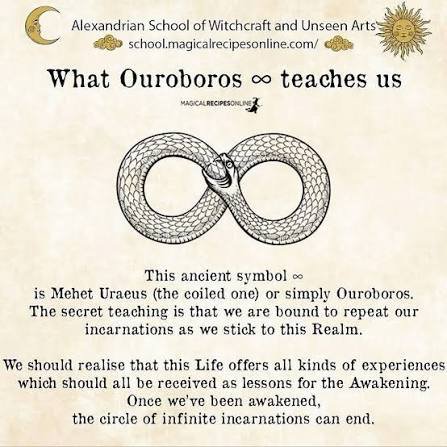
An ouroboros tattoo shows a snake or dragon biting its own tail, forming a closed circle. It’s one of the oldest symbols still used in modern tattoo art. Its meaning has stayed remarkably consistent across thousands of years and dozens of cultures. Here’s what the ouroboros tattoo actually represents.
Quick Facts
| What it depicts | A serpent or dragon consuming its own tail |
| Earliest known origin | Ancient Egypt, found in tomb art linked to Tutankhamun |
| Name origin | Greek for “tail” (oura) and “eating” (boros) |
| Core symbolism | Infinity, cyclical renewal, unity of opposites |
| Key cultures | Egyptian, Greek, Norse, alchemical traditions |
| Modern interpretation | Carl Jung linked it to psychological wholeness and self-integration |
Where the Ouroboros Symbol Comes From
The ouroboros isn’t tied to a single myth or story the way some tattoo symbols are. It shows up independently across several ancient cultures. Each one arrived at a similar meaning through a different tradition.
Its earliest known appearance comes from ancient Egypt, found among the funerary art connected to Tutankhamun’s tomb. The Greeks later adopted and named the symbol. They combined their words for “tail” and “eating” into the term still used today. In Norse mythology, a version of the symbol appears as Jörmungandr, a massive serpent that encircles the entire world. Alchemists in the medieval and early modern periods used the ouroboros to represent the unity of opposing forces and the transformation of raw material into something refined.
The same basic image kept reappearing across unconnected cultures. That’s part of why the symbol carries such weight. It wasn’t invented once and borrowed afterward. It was arrived at independently, again and again, as a way of representing a cycle with no clear beginning or end.
What an Ouroboros Tattoo Symbolizes
Most interpretations of the ouroboros tattoo cluster around a few core ideas:
- Infinity and eternal renewal. A circle with no start or end point naturally reads as a symbol of something endless. That’s why the ouroboros is often grouped with other infinity symbols.
- Cycles of life, death, and rebirth. The snake consuming itself mirrors the way endings and beginnings are connected rather than separate.
- Unity and wholeness. A closed loop suggests completeness. This is why the symbol appears in alchemical texts alongside ideas about combining opposing elements into one.
- Self-reflection and transformation. The snake’s action is directed entirely at itself. Many wearers read the design as a symbol of introspection or personal change.
The Psychological Reading: Carl Jung and the Ouroboros
One of the more substantial interpretations of the ouroboros tattoo comes from psychology rather than mythology. Carl Jung, the Swiss psychiatrist known for his work on archetypes and the unconscious mind, referenced the ouroboros as a symbol for a specific stage of psychological development.
In Jung’s framework, the ouroboros represents an early, undifferentiated state of the self. This is before a person has fully separated their identity from their surroundings. As that process of separation and integration continues, the symbol comes to represent something closer to wholeness. It becomes a self that has confronted its own contradictions and folded them into a single, complete identity rather than staying fragmented. For people drawn to the ouroboros tattoo as a marker of personal growth, this reading often carries more specific weight than the broader “cycle of life” interpretation.
Common Design Variations
The ouroboros tattoo lends itself to a wide range of visual styles, more so than many symbolic designs:
- Minimalist line work, often just a thin outline of the snake forming a simple circle, suited to smaller placements like the wrist or behind the ear
- Detailed, illustrative designs with scales, shading, and a more dragon-like head
- Combined with other symbols, such as florals or astrological signs, to layer in additional personal meaning
- Tribal-style interpretations, using bold geometric lines rather than a realistic serpent
Placement often depends on the level of detail. A simple circular outline works well on the wrist or ankle. A more elaborate version benefits from a larger canvas like the forearm, back, or calf.
Frequently Asked Questions
What does an ouroboros tattoo mean?
It generally symbolizes infinity, cyclical renewal, and the unity of life and death, though interpretations vary by individual.
Where did the ouroboros symbol originate?
Its earliest known depiction comes from ancient Egypt, though it also appears independently in Greek, Norse, and alchemical traditions.
Is the ouroboros a religious symbol?
It isn’t tied to one specific religion. It appears across multiple belief systems and philosophical traditions. There’s some overlap with concepts in Hinduism and Buddhism around cyclical existence.
What’s the difference between an ouroboros and a regular snake tattoo?
A standard snake tattoo can carry many different meanings depending on the design. An ouroboros tattoo specifically shows a snake or dragon consuming its own tail, which narrows its meaning toward cycles and infinity.
Did Carl Jung really write about the ouroboros?
Yes. Jung used the symbol to describe a stage of psychological development related to self-integration and confronting internal contradictions.
The Bottom Line
The ouroboros tattoo endures because its meaning hasn’t drifted much from its ancient origins. Someone might read it as a symbol of infinity, a marker of personal transformation, or a nod to Jung’s psychological framework. The core idea stays the same either way: an ending that feeds directly back into a beginning, with no true separation between the two.
It’s not the only literary or symbolic tattoo built around a single, weighty idea. The poison tree tattoo draws on a similar approach, taking a specific piece of writing and turning it into a lasting visual reminder. It deals with a very different emotional theme than the ouroboros does, though.