


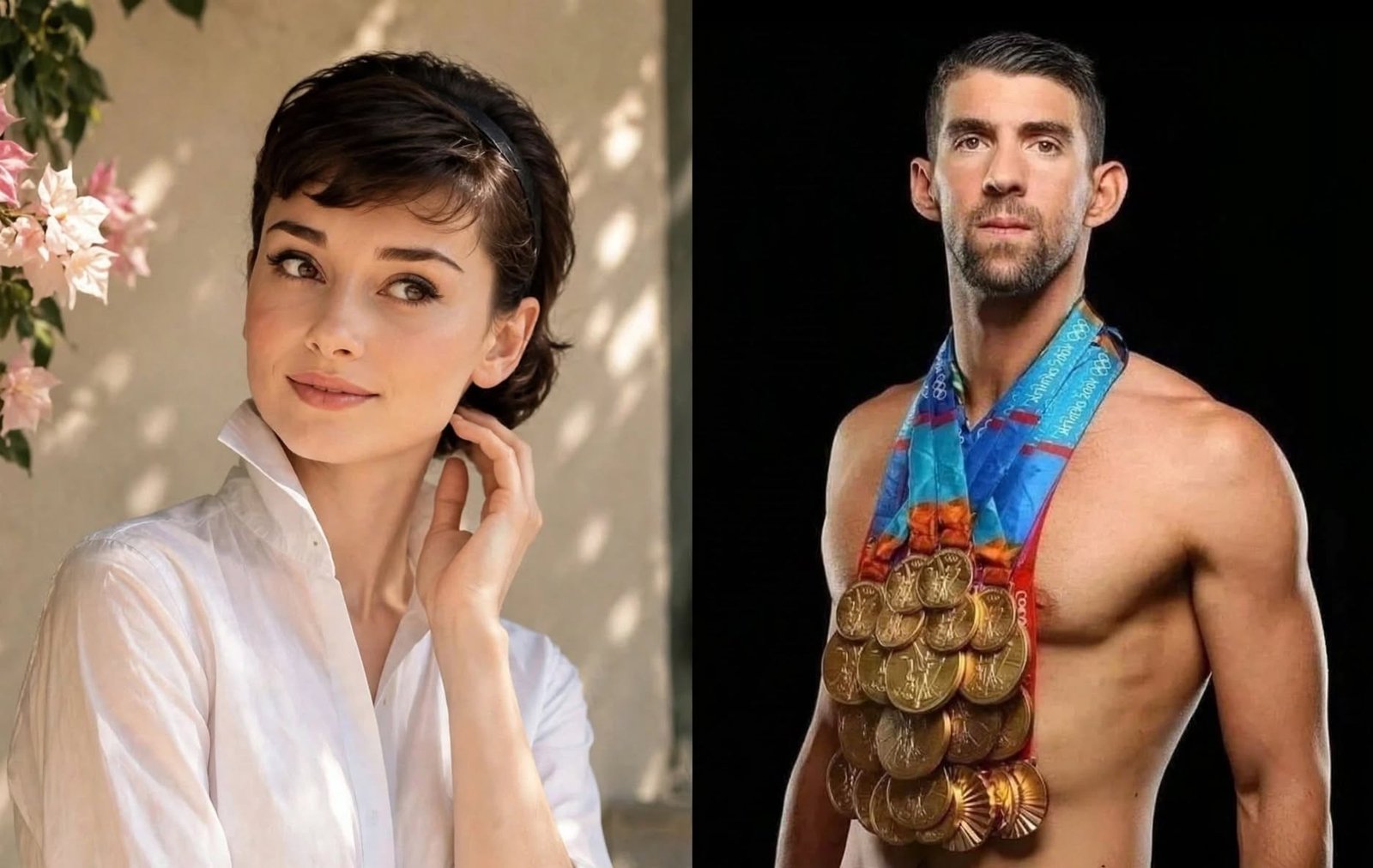
Audrey Hepburn passed away decades before Michael Phelps swam his first Olympic race. One built her legacy in front of a camera in 1950s Hollywood; the other built his in a swimming pool in the 2000s. On paper, there’s no reason these two names should appear in the same sentence. But both are held up as the defining figure of their field — Hepburn as the standard for screen elegance, Phelps as the standard for Olympic dominance — and both ended up using that platform for something bigger than the work that made them famous.
Quick Comparison
| Audrey Hepburn | Michael Phelps | |
| Field | Film and fashion | Competitive swimming |
| Active years | 1948–1989 | 2000–2016 (Olympic career) |
| Signature achievement | Oscar-winning performance in Roman Holiday (1953) | 28 Olympic medals, 23 gold — most decorated Olympian in history |
| Beyond the craft | UNICEF Goodwill Ambassador (1988–1993) | Mental health advocate, founder of the Michael Phelps Foundation |
| Defining trait | Restraint and elegance in an era of Hollywood spectacle | Relentless work ethic and record-breaking consistency |
| Lasting title | Third-greatest female screen legend (American Film Institute) | Most decorated Olympian of all time |
Audrey Hepburn: The Actress Who Redefined Elegance
Hepburn’s path to Hollywood wasn’t a straight one. Born in Belgium in 1929, she spent part of her childhood in Nazi-occupied Netherlands, an experience of wartime scarcity that shaped her worldview long before she ever stepped in front of a camera. She trained as a ballet dancer first, and that background shows up clearly in the controlled, precise physicality she brought to every film role.
Her breakout came with Roman Holiday in 1953, a performance that won her an Academy Award, a Golden Globe, and a BAFTA — a sweep no other actress had managed for a single role at that point. She followed it with a run of films that are still cultural reference points today: Sabrina, Funny Face, Breakfast at Tiffany’s, Charade, and My Fair Lady. Her collaboration with designer Hubert de Givenchy did as much to shape fashion history as her filmography did to shape acting.
Michael Phelps: The Most Decorated Olympian Ever
Phelps’ story runs on a completely different track — literally. Born in Baltimore and diagnosed with ADHD as a child, he started swimming at age seven and by seven Olympic Games later had assembled a medal count no other athlete, in any sport, has come close to matching: 28 Olympic medals, including 23 gold.
His single most famous achievement came at the 2008 Beijing Olympics, where he won eight gold medals in a single Games — a record that stood alone for its combination of volume and dominance. He competed across five Olympics, from Sydney 2000 to Rio 2016, setting world records along the way and becoming, by a wide margin, the most decorated athlete the Olympics has ever produced.
The Real Parallel: Turning Fame Into Advocacy
The most interesting connection between Hepburn and Phelps isn’t their fame — it’s what each of them did with it once they had it.
Hepburn spent the final years of her life almost entirely on humanitarian work. Starting in 1988, she traveled to some of the poorest regions of Africa, South America, and Asia as a UNICEF Goodwill Ambassador, work she continued until shortly before her death in 1993. She received the US Presidential Medal of Freedom for that work months after her passing — recognition that had little to do with any film role.
Phelps’ second act has followed a similar arc, even if the cause is different. After retiring from competition, he became one of the most visible advocates for athlete mental health in modern sports, speaking openly about his own struggles with depression and anxiety. His foundation focuses on water safety and youth confidence rather than swimming performance, and he’s continued that advocacy work through partnerships with mental health platforms well into his post-competitive career.
Neither of them had to do this. Both were famous enough to coast on their original achievement alone. Instead, both chose to redirect a global platform toward something outside the field that built it — Hepburn toward child welfare, Phelps toward mental health.
Different Eras, Different Kinds of Fame
It’s worth noting how differently fame actually worked for each of them. Hepburn’s stardom was built and sustained through a handful of films released years apart, with press coverage that moved at the pace of print magazines and premieres. Phelps’ fame was compressed into intense four-year cycles, amplified by television and, later, social media, where a single race could make him a global name overnight.
That difference in pace shaped how each of them was perceived. Hepburn’s image had years to be carefully shaped and maintained; Phelps’ highs and lows — including a widely covered DUI arrest early in his career — played out in a media environment with far less room for privacy.
Frequently Asked Questions
Did Audrey Hepburn and Michael Phelps ever have any connection? No direct connection exists between them. They belong to entirely different eras and fields; the comparison is about the scale of their legacies, not any personal relationship.
Who is considered more accomplished in their respective field? Both are widely regarded as the top figure in their domain — Hepburn is ranked among the greatest actresses in classic Hollywood history, while Phelps holds the record for most Olympic medals ever won by any athlete.
Is Michael Phelps still involved in swimming? He retired from competitive swimming after the 2016 Rio Olympics but remains connected to the sport through broadcasting, commentary, and his foundation’s water-safety programs.
What is Audrey Hepburn best remembered for besides acting? Her humanitarian work with UNICEF in the final years of her life is often cited as being just as significant to her legacy as her film career.
The Bottom Line
Audrey Hepburn and Michael Phelps never crossed paths, competed in nothing resembling the same arena, and belong to different generations entirely. What connects them isn’t circumstance — it’s the choice both made to use once-in-a-generation fame for something beyond the achievement that created it. That’s a rarer parallel than shared talent, and arguably a more meaningful one.
For another look at how athletic greatness translates into lasting influence, our profile of Michael Jordan’s $4.3 billion net worth covers a similar story of a career built well beyond the scoreboard.