


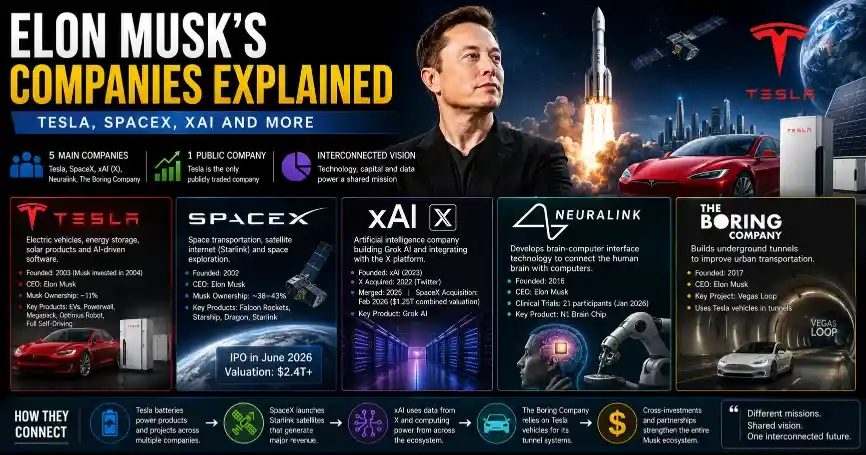
Tesla gets most of the headlines, but it’s only one piece of a much larger picture. Elon Musk’s companies now span electric cars, rockets, brain implants, tunnels, and artificial intelligence, and most people can name maybe two of them. Here’s a clear breakdown of what each one actually does and how they connect.
How Many Companies Does Elon Musk Actually Own
Musk currently owns or holds a controlling stake in five main companies: Tesla, SpaceX, xAI (which absorbed X, formerly Twitter), Neuralink, and The Boring Company. He also co-founded PayPal in the late 1990s, though he no longer has any ownership stake there, having sold his shares when eBay acquired the company in 2002 for $1.5 billion.
Tesla is the only one of these that’s publicly traded, which is why its value gets reported constantly. The rest are privately held, meaning their valuations come from funding rounds and reported deals rather than a live stock price anyone can check.
Read More: Elon Musk Net Worth Today: Full Breakdown
Tesla: The Public Centerpiece
Tesla designs and manufactures electric vehicles, energy storage systems, and solar products, and it remains the most visible and easiest to track of all Musk’s ventures since it trades publicly. Musk first backed Tesla in 2004 and has led the company as CEO since 2008, building it from a niche electric vehicle maker into one of the most valuable automakers in the world.
Beyond cars, Tesla has pushed into autonomous driving software and the Optimus humanoid robot project, both bets on where the company’s technology could expand next. Musk owns close to 11 percent of Tesla directly, according to Forbes’ profile of Elon Musk, a figure that excludes unvested restricted stock from his 2018 CEO performance award that could eventually add several more percentage points once vesting conditions are met.
SpaceX: The Largest Private Company Turned Public
SpaceX, founded in 2002, is the leading private launch company and the only one to return a spacecraft from low-Earth orbit and carry humans to and from the International Space Station. It also owns Starlink, the satellite internet provider that generated $4.4 billion in operating income last year, making it one of SpaceX’s most reliably profitable divisions even while other parts of the business run at a loss.
SpaceX went public in June 2026, opening its first day of trading at a valuation near $2 trillion before climbing past $2.43 trillion within days. Musk’s ownership stake, reported between 38 and 43 percent depending on the source and whether options are included, is now the single largest piece of his overall net worth.
xAI and X: Musk’s AI and Social Media Play
Musk launched xAI in July 2023 with the stated goal of understanding the true nature of the universe, positioning it to compete directly with companies like OpenAI and Google DeepMind. Its flagship product, the Grok AI assistant, is trained using a massive supercomputer cluster called Colossus, built in Memphis and powered by more than 100,000 Nvidia GPUs.
In February 2026, SpaceX acquired xAI in an all-stock transaction that valued the combined entity at roughly $1.25 trillion, tying Musk’s AI ambitions directly to his space company’s infrastructure. X, the social platform Musk acquired for $44 billion in 2022 after it was still called Twitter, had already been merged into xAI the year before that deal, giving the AI company direct access to a platform with more than 600 million monthly active users and a steady stream of real-time data to train on.
Neuralink: The Medical Technology Bet
Neuralink, co-founded by Musk in 2016, develops brain-computer interface technology designed to connect the human nervous system directly to a computer. Its N1 chip, implanted using a purpose-built robotic surgeon, places over a thousand electrode threads into the brain’s cortex to record neural activity.
The company has moved into clinical trials for people with spinal cord injuries, ALS, and other neurological conditions, reporting 21 trial participants worldwide as of January 2026. It remains early-stage technology, but supporters believe it could eventually help restore communication and mobility for people with severe disabilities, while critics point to the ethical and safety questions that come with implanting experimental hardware directly into the human brain.
The Boring Company: Tunnels as a Transit Bet
Founded in 2017, The Boring Company builds underground tunnels aimed at reimagining urban transit. Its most visible project, the Vegas Loop, moves passengers between the Las Vegas Convention Center and nearby hotels using Tesla vehicles driven through a network of tunnels beneath the city.
Critics have described the project as an expensive, limited-capacity system that functions more like a glorified valet service than genuine mass transit. Supporters counter that it’s a proof of concept for a tunnel-based transit model that could eventually scale to other cities if the underlying economics improve.
Read More: Richest People in the World 2026
How These Companies Actually Connect
None of these five companies operate in complete isolation. Tesla’s battery and AI expertise feeds into Optimus and its autonomous driving software, while SpaceX’s rockets launch the Starlink satellites that generate a meaningful share of the company’s revenue. Tesla sold $430 million in Megapacks to xAI in 2025 and has separately invested $2 billion directly into the AI startup, tying two seemingly unrelated ventures together through both hardware sales and equity.
xAI’s Grok model draws on data from X, the platform it absorbed, while The Boring Company relies entirely on Tesla vehicles to move passengers through its tunnels. This interlocking structure means a setback or breakthrough at one company often ripples into how the others are valued, which is part of why untangling Musk’s overall net worth requires looking at all five businesses together rather than any single one in isolation.
Frequently Asked Questions
How many companies does Elon Musk currently own? Musk owns or controls five main companies: Tesla, SpaceX, xAI (which includes X), Neuralink, and The Boring Company. He also co-founded PayPal decades ago but no longer holds any stake in it.
Which of Elon Musk’s companies is worth the most? SpaceX, following its June 2026 IPO, is now the most valuable of Musk’s companies, with a market capitalization that surpassed $2.4 trillion within days of going public, ahead of Tesla’s roughly $1.5 trillion valuation.
Does Elon Musk still own PayPal? No. Musk co-founded X.com in the late 1990s, which later merged into what became PayPal. He sold his shares when eBay acquired the company in 2002 for $1.5 billion and has had no ownership stake since.
What does xAI actually do?
xAI develops artificial intelligence models, most notably the Grok chatbot, and merged with SpaceX in February 2026 to combine AI development with the company’s satellite and computing infrastructure.
Is Neuralink currently available to the public?
No. Neuralink remains in clinical trials, currently limited to a small number of participants with specific medical conditions like spinal cord injuries and ALS, rather than being available for general use.
How are Musk’s companies financially connected?
Several of his companies do business directly with one another. Tesla has sold battery products to xAI and invested capital into it directly, while The Boring Company relies on Tesla vehicles for its tunnel transit system.
Final Thoughts
Elon Musk’s companies explained side by side show a pattern that isn’t always obvious from the headlines: Tesla, SpaceX, xAI, Neuralink, and The Boring Company aren’t five unrelated bets so much as an interconnected group that shares technology, capital, and, increasingly, valuation. Understanding how they fit together makes it much easier to follow why news about any single one of them tends to move the conversation around all the others too.
Written by the MagazineMedias Celebrity Desk, covering wealth, business, and the public figures behind the headlines.