

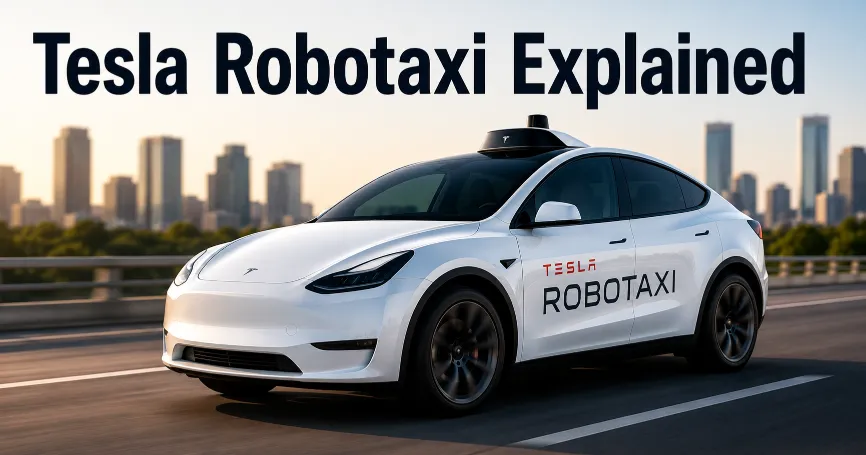
Can you actually ride in a Tesla robotaxi yet? Or is it still just a demo? The answer depends entirely on which city you’re in. Tesla’s driverless ride-hailing service has quietly gone from a single invite-only pilot to a multi-city operation in about a year. The rules, pricing, and vehicle itself are still evolving as it grows. Here’s the Tesla Robotaxi explained clearly, covering how it works, where it’s live, and when you might actually be able to buy one.
What Is Tesla Robotaxi and How Does It Work
Think of Tesla Robotaxi as Tesla’s own version of Uber, minus the person behind the wheel. Riders pull up the dedicated app, type in where they want to go, check the fare and estimated wait, and then tap to confirm. The car pulls up on its own. In cities running “unsupervised” mode, nobody sits up front to take over.
Once the ride starts, passengers can tweak small things, like temperature or what’s playing on the screen. Every driving decision comes from Tesla’s Full Self-Driving software, which runs on the car’s cameras. It merges lanes, brakes for pedestrians, and reads the road in real time without a person steering, though a remote support line stays on standby in case something goes sideways.
Right now, the fleet running these rides is made up mostly of modified Model Y and Model 3 vehicles rather than Tesla’s purpose-built robotaxi, the Cybercab. The Model Y and Model 3 rides use Tesla’s Full Self-Driving software, adapted for autonomous ride-hailing use. At the same time, the Cybercab is a separate, two-seat vehicle still ramping up production.
Read More: Tesla Robotaxi Miami
Tesla Robotaxi Release Date and Timeline
Tesla’s robotaxi story started well before the service most people recognize today. The Cybercab itself was unveiled in October 2024, showing a two-passenger vehicle with no steering wheel or pedals. Twenty prototypes gave attendees short demo rides at that unveiling event, well before any public ride-hailing service existed.
The actual ride-hailing pilot launched on June 22, 2025, in Austin, Texas, using modified Model Y vehicles with safety drivers on board. It was invite-only at first, running in a geofenced area with a flat fare of $4.20 per ride. That cautious start changed on January 22, 2026, when Tesla began offering fully driverless rides in Austin with no safety monitor inside the vehicle, a genuine milestone for the program.
From there, expansion moved quickly. Tesla announced plans on its Q4 2025 earnings call, held January 28, 2026, to launch in seven new cities during the first half of 2026: Dallas, Houston, Phoenix, Miami, Orlando, Tampa, and Las Vegas. Dallas and Houston went live with unsupervised rides ahead of schedule. Miami followed on July 3, 2026. By Tesla’s Q2 2026 earnings call on July 22, the company confirmed active service in Austin, Miami, Orlando, and Tampa, alongside supervised rides in the San Francisco Bay Area, where California law still requires a safety driver.
That pace surprised even close industry watchers. Early reports on X showed the number of cities with unsupervised Tesla Robotaxi service tripling within a single day during the Dallas and Houston rollout, well ahead of the broader first-half-of-2026 timeline Tesla had originally outlined on its earnings call. By mid-2026, the combined service area across all active cities had grown to roughly 1,190 square miles.
Where Is Tesla Robotaxi Available Right Now
As of late July 2026, Tesla Robotaxi operates in a handful of confirmed markets, though the exact list keeps shifting as the rollout continues.
| City | Status | Safety Driver Required |
|---|---|---|
| Austin, TX | Unsupervised, expanded to full metro area | No |
| Dallas, TX | Unsupervised | No |
| Houston, TX | Unsupervised | No |
| Miami, FL | Unsupervised, geofenced western Miami-Dade | No |
| Orlando, FL | Active per Q2 2026 update | No |
| Tampa, FL | Active per Q2 2026 update | No |
| San Francisco Bay Area, CA | Supervised | Yes, it is required by state law |
Built In’s Tesla Robotaxi explainer notes that Tesla expanded to Dallas and Houston shortly after Austin, describing it as part of a wider planned US rollout tied to Cybercab production ramping up. Phoenix and Las Vegas were also announced for the first half of 2026, though public launch confirmation for those two cities was still pending as of this writing.
The pattern across every city so far has been the same: start with a small geofenced zone, gather real-world data on local traffic and weather conditions, then expand the coverage area gradually. Austin’s initial zone, for example, has since grown to cover the entire metro area, while Miami launched with a much smaller 10 to 14 square mile zone in western Miami-Dade County that excludes downtown, Brickell, and Miami Beach entirely for now.
The Tesla Cybercab: Can You Actually Buy One
This is where a lot of confusion comes from. The Cybercab, Tesla’s purpose-built robotaxi with no steering wheel or pedals, is not available for personal purchase yet. It exists only as part of Tesla’s own ride-hailing fleet right now.
Production tells a more advanced story than the buying option does. The first production Cybercab unit was built in February 2026. Continuous production began in April 2026 at Gigafactory Texas. By July 2026, more than 100 production units had been spotted at the factory and across testing locations in over 40 cities, though nearly all current unsupervised rides still use modified Model 3 and Model Y vehicles rather than the Cybercab itself.
Tesla has targeted 2027 for consumer sales of the Cybercab, with a price under $30,000. Until then, if you want to experience the technology, riding as a passenger through the app is the only option. Pre-orders haven’t opened as of this writing. Tesla has stated plainly that this isn’t something you can buy today.
The vehicle itself looks nothing like a standard Tesla. It’s a two-door coupe designed to seat two passengers, built around a 35 to 48 kWh battery depending on the specification, with an electric range estimated between 200 and 418 miles. Tesla plans to use a new “unboxed” manufacturing process for the Cybercab, aiming eventually for production cycles as fast as five seconds per vehicle, compared to roughly 34 seconds for a Model Y. The company’s long-term target is to build 2 million Cybercabs a year across multiple factories once the process is fully scaled.
What a Tesla Robotaxi Ride Is Actually Like
Early rider accounts across Austin, Houston, and Miami paint a fairly consistent picture. The car handles routine situations smoothly, including yielding to emergency vehicles and navigating through heavy rain without hesitation. Field reports from Miami specifically noted the vehicle coming to a complete stop for an approaching ambulance with sirens on. It also drove steadily through flooded streets at low speed without any remote takeover required.
Not every ride goes perfectly, though. Some early riders in Miami reported the app displaying an “unable to start your ride” error on a majority of trip attempts, requiring a call to remote support before the trip could begin. Tesla has treated these early hiccups as part of the expected process of scaling a brand-new service into a new city, rather than a sign of a deeper technical problem with the underlying self-driving software itself.
How Much Does a Tesla Robotaxi Ride Cost
Pricing has evolved since the earliest pilot days. The original Austin pilot charged a flat $4.20 fare within its geofenced area. Current pricing varies by city and distance, shown as an estimate in the app before you confirm a ride.
Looking at operating costs rather than rider-facing fares gives a clearer picture of where this is headed. Tesla has targeted an operating cost of $0.20 per mile, covering charging, insurance, and depreciation. Morgan Stanley has estimated Tesla’s current actual operating cost closer to $0.81 per mile, still notably lower than Waymo’s estimated $1.43 per mile and traditional rideshare services at roughly $1.71 per mile. If Tesla’s cost advantage holds as the fleet scales, it could translate into meaningfully cheaper rides than competitors over time.
Is Tesla Robotaxi Safe
Safety data on the program remains limited but public. Between July 2025 and March 2026, the National Highway Traffic Safety Administration documented 17 incidents involving the Austin robotaxi fleet. Six were minor contact events where Tesla’s autonomous system was found at fault or partially at fault. Two involved remote teleoperators driving into objects at low speed. Notably, zero major crashes were recorded during that period.
NHTSA also maintains a broader engineering analysis investigation covering Tesla’s Full Self-Driving software across 3.2 million vehicles, separate from the robotaxi-specific incident reports. Federal regulators, along with the Department of Transportation, have been actively involved throughout the rollout, including a proposal to eliminate steering wheel and brake pedal requirements for vehicles designed exclusively for autonomous driving, a change that would directly benefit the Cybercab’s design once it reaches wider deployment.
Tesla Robotaxi vs Waymo: A Quick Note
Tesla isn’t operating in a vacuum here. Waymo remains the more established driverless ride-hailing competitor, already running in more markets with a larger fleet. According to Morgan Stanley’s estimates, Waymo also carries a higher per-mile operating cost than Tesla’s current figures. Uber has also entered this space through partnerships, investing more than $10 billion into expanding its own robotaxi ambitions, including its existing Waymo partnership in cities like Atlanta and Austin. A full side-by-side comparison deserves its own detailed breakdown, covering technology approach, coverage area, and safety record in more depth than fits here.
More exploration of this article: Waymo vs Tesla Robotaxi
Frequently Asked Questions
Is the Tesla Robotaxi actually driverless?
In several cities, yes. Austin, Dallas, Houston, and Miami all currently run unsupervised rides with no human safety driver inside the vehicle. The Bay Area still requires a safety driver due to California state law.
What cities have the Tesla robotaxi right now?
As of late July 2026, confirmed active markets include Austin, Dallas, Houston, Miami, Orlando, Tampa, and the San Francisco Bay Area, with Phoenix and Las Vegas announced but not yet publicly confirmed as launched.
Can I buy a Tesla robotaxi or Cybercab today?
No. The Cybercab is not available for personal purchase yet. Tesla has targeted 2027 for consumer sales at a price under $30,000. Pre-orders have not opened as of this writing.
What app do I need to ride in a Tesla robotaxi?
You need the dedicated Robotaxi app, separate from Tesla’s regular vehicle app, using your existing Tesla account credentials to sign in and request a ride within the available service area.
How much does a Tesla robotaxi ride cost?
Pricing varies by city and distance, shown as an estimate before you confirm. The original Austin pilot charged a flat $4.20 fare, though current pricing across cities reflects standard distance-based rates shown in the app.
Is the Tesla Robotaxi safer than a regular taxi?
It’s too early to say definitively. NHTSA recorded 17 incidents in the Austin fleet between July 2025 and March 2026, with zero major crashes. The dataset remains small compared to the scale needed for a confident safety comparison against traditional taxis.
Final Thoughts
Tesla Robotaxi has moved faster than many expected, from a single invite-only Austin pilot in mid-2025 to unsupervised rides across multiple states within about a year. The purpose-built Cybercab still isn’t for sale and won’t be until at least 2027, which means for now, the only way to experience the service is as a passenger through the app in one of the growing but still limited number of cities where it currently operates.
Keep an eye on Tesla’s quarterly earnings calls for the clearest updates on both city expansion and cybercab production, since that’s where the company has consistently announced its next moves so far. The pace of the past year suggests the list of available cities will likely look different again within just a few months.
Written by the MagazineMedia Tech Desk, covering the technology and companies shaping how we live and work.