


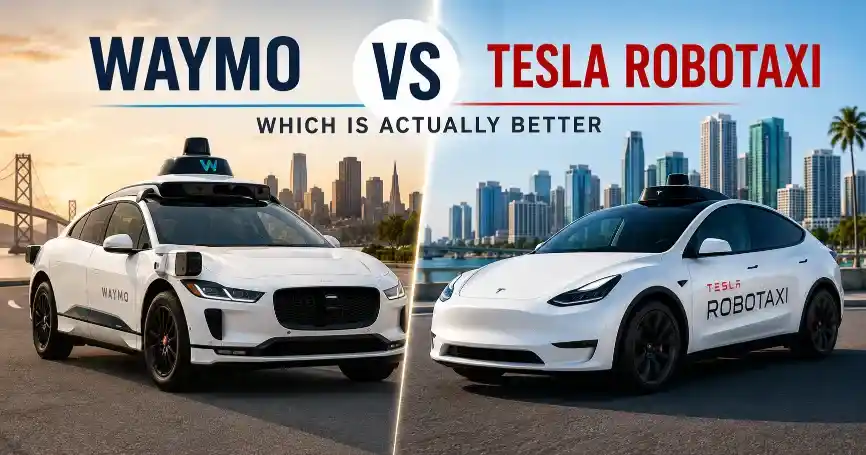
Is Tesla’s robotaxi fleet really catching up to Waymo? Or does the gap between them just look smaller from the outside? Depending on which source you check, Tesla’s fleet is either scaling toward tens of thousands of vehicles or sitting at a few dozen. Here’s what the real 2026 numbers say about Waymo and Tesla, without leaning on either company’s own marketing.
Waymo vs Tesla Robotaxi at a Glance
| Category | Waymo | Tesla Robotaxi |
|---|---|---|
| Technology | Cameras, lidar and radar | Cameras only |
| Active fleet (verified, mid-2026) | ~3,791 vehicles (NHTSA filing) | ~34 vehicles (Electrek tracking) |
| Cities | 10+ US metros | Austin, Dallas, Houston, Miami, Bay Area (supervised) |
| Weekly rides | ~500,000 | Not publicly disclosed at scale |
| Est. cost per mile | ~$1.43 | $0.20 to $0.81 |
| 2025 revenue | $286 million+ | Not yet disclosed separately |
| Recent safety issue | Two fleet recalls in 5 weeks (2026) | 17 NHTSA-documented incidents, zero major crashes (Jul 2025 to Mar 2026) |
| Overall scale leader | ✅ Yes, by a wide margin | ❌ Not yet |
| Cost leader | ❌ No | ✅ Yes, on paper |
Two Completely Different Bets on Self-Driving
Waymo and Tesla are solving the same problem with opposite philosophies. Waymo, Alphabet’s self-driving subsidiary, uses a full sensor suite combining cameras, lidar and radar, layered with years of mapping work in each city it operates in. Tesla relies entirely on cameras and neural networks, betting that vision alone, paired with data from millions of consumer vehicles already on the road, can eventually handle any road anywhere without expensive extra hardware.
That difference shows up directly in cost. Bloomberg Intelligence has estimated Waymo’s sensor and hardware setup at roughly seven times more expensive per vehicle than Tesla’s approach, whose some industry estimates put around $2,000 in added hardware cost. Tesla’s bet is that cheaper hardware means faster, cheaper scaling. Waymo’s bet is that more sensors mean safer, more reliable performance sooner.
Neither approach is objectively wrong so far. Waymo’s years of lidar-based mapping have let it deploy confidently in complex urban environments faster than Tesla has managed with a newer, still-maturing camera-only system. Tesla’s argument is a longer-term one: that a system trained purely on vision can eventually generalize to any road without the costly, city-by-city mapping process Waymo depends on, even if that promise remains largely unproven at scale today.
Read More: Tesla Robotaxi Miami: First Field Report and How to Ride
Fleet Size: Where the Real Disagreement Starts
This is where sources genuinely stop agreeing. It’s worth understanding why before trusting any single fleet number you see quoted, since the two companies define and report their fleets in very different ways.
Waymo’s scale is well documented through its own regulatory filings. NHTSA recall filings from May 2026 covered 3,791 Waymo vehicles, up from 1,212 a year earlier, roughly triple in twelve months. The company is also building a manufacturing plant in Mesa, Arizona, with Magna to add another 2,000 vehicles to that total.
Tesla’s numbers are murkier and depend heavily on which source you check. Tesla itself has pointed toward ambitious projections, with some industry estimates suggesting a fleet approaching 35,000 vehicles by the end of 2026. Independent tracking tells a very different story. Robotaxi Tracker data reported by Electrek in late May 2026 put Tesla’s actual active fleet at around 34 vehicles across all its ride-hailing operations, with only 20 running fully unsupervised: 14 in Austin, 3 in Dallas, and 3 in Houston. Texas state registration filings showed 42 robotaxis registered, though registered and actively running are two different things entirely.
That gap between projection and verified count is enormous by any standard, roughly a thousand-fold difference between the optimistic estimate and the independently tracked figure. Some of that gap is explained by timing, since Tesla’s Cybertruck production only began ramping in early 2026 and most of the projected fleet growth was always expected to arrive later in the year rather than all at once. Even accounting for that, the disconnect between Tesla’s public framing and its currently verifiable numbers is large enough that any comparison built purely on projections rather than tracked data risks being seriously misleading.
Cities and Availability
Waymo currently operates in 10 or more US metros, with executives targeting entry into at least 20 cities globally in the coming years. Weekly ride volume has reportedly reached around 500,000 paid rides, with a stated goal of 1 million weekly rides by the end of 2026.
Tesla’s footprint remains far more concentrated. As of mid-2026, fully unsupervised service is confirmed in Austin, Dallas, Houston, and Miami, with supervised rides continuing in the San Francisco Bay Area under California’s safety driver requirement. Elon Musk projected 500 Tesla robotaxis in Austin alone by the end of 2025, a target that wasn’t met based on the vehicle counts tracked so far.
There’s also a notable difference in how each company approaches new markets. Uber has integrated Waymo into its own app in select cities, letting riders request a Waymo vehicle the same way they’d request any other ride, which effectively taps into an existing user base rather than requiring Waymo to build demand from scratch. Tesla has taken the opposite approach, keeping its Robotaxi service entirely within its own dedicated app and requiring an existing Tesla account to even sign up.
Cost Per Ride: Tesla’s Clearest Advantage
If there’s one dimension where Tesla holds a fairly uncontested lead, it’s cost. Tesla has targeted an operating cost around $0.20 per mile, covering charging, insurance, and depreciation, though Morgan Stanley estimates the company’s actual current cost closer to $0.81 per mile. Either figure sits well below Waymo’s estimated $1.43 per mile, a gap that traces directly back to the sensor cost difference between the two approaches.
Waymo’s revenue picture, meanwhile, shows a business that’s already generating real money at scale. The company reported over $286 million in revenue during 2025 from 14 million fully driverless trips, at an average fare of $20.43 per ride, a tripling of trip volume from the year before.
This creates an interesting tension for anyone trying to declare a clear winner on cost. Tesla’s per-mile figures look better on paper. Waymo is the one with a fully proven, audited revenue stream at meaningful scale right now. A cheaper theoretical cost structure matters less if it can’t yet support the ride volume needed to prove it out in practice. Tesla’s small current fleet means its cost advantage remains largely unproven at the scale Waymo already operates at.
Safety Record: A More Complicated Picture Than the Headlines Suggest
Neither company has a spotless safety record. 2026 brought real setbacks for both. Waymo recalled its fleet twice within a five-week stretch this year, despite its longer operating history and more conservative sensor-heavy approach. Tesla, for its part, has faced its own scrutiny: NHTSA maintains a broader engineering analysis investigation covering Full Self-Driving software across 3.2 million vehicles, separate from robotaxi-specific incident tracking in Austin, where 17 incidents were documented between July 2025 and March 2026, six of them minor contact events with zero major crashes recorded.
Neither recall history nor incident count tells the full story on its own. Waymo’s recalls affected a fleet operating at a scale roughly a hundred times larger than Tesla’s, meaning its issues touched far more actual rides even at a similar or lower rate per vehicle. Tesla’s smaller scale means fewer total incidents by simple math, though it also means there’s less real-world data available to judge how the system performs once it’s running thousands of vehicles rather than dozens.
Ride quality comparisons from outlets like MotorTrend have noted that Tesla’s software occasionally produces more aggressive maneuvers, like abrupt lane changes, while Waymo’s rides tend to feel smoother but remain confined to a more limited, thoroughly mapped area.
Why This Race Matters Beyond the Two Companies
The stakes here go well past bragging rights between Tesla and Waymo. The global robotaxi market was valued at roughly $789.3 million in 2024 and is projected to grow to $96.9 billion by 2032, according to MarketsandMarkets, an annual growth rate above 82 percent. Analysts have predicted a global fleet of around 934,000 robotaxis by 2035, meaning whichever approach wins this early phase could shape how autonomous transportation gets built worldwide, not just in the handful of US cities where both companies currently operate.
Other players are watching closely too. Uber has committed over $10 billion toward expanding its own robotaxi ambitions, partly through its existing Waymo partnership and partly through independent efforts, signaling that neither Tesla nor Waymo is likely to have this market entirely to itself even if one pulls decisively ahead of the other in the next few years.
So Which One Is Actually Better
The honest answer depends entirely on what “better” means to you. On pure scale, deployed vehicles, and proven revenue, Waymo is winning clearly and by a wide margin right now, not by a close call. On cost structure and long-term scaling potential, Tesla’s camera-only approach has a real theoretical advantage, assuming the software keeps improving fast enough to justify skipping the extra sensors Waymo relies on.
The gap between Tesla’s stated ambitions and its currently tracked fleet size is the single most important thing to understand before believing any headline claiming Tesla is “catching up. ” Right now, based on independently tracked numbers rather than either company’s own projections, it isn’t close. Whether that changes depends on how quickly Tesla’s Cybercab production ramps and how much regulatory approval the company secures for expanding unsupervised service into denser cities.
Read More: Tesla Robotaxi Explained
Frequently Asked Questions
Is Waymo bigger than Tesla’s robotaxi right now?
Yes, significantly. Waymo’s fleet sits in the thousands based on its own NHTSA filings, while independently tracked data puts Tesla’s active fleet at roughly 34 vehicles as of mid-2026.
Is Tesla Robotaxi actually catching up to Waymo?
Not based on current independently tracked numbers. Tesla has stated ambitious growth projections. Its confirmed active fleet remains far smaller than Waymo’s documented scale.
Which is cheaper, Waymo or Tesla Robotaxi?
Tesla holds a clear cost advantage, with an estimated operating cost between $0.20 and $0.81 per mile compared to Waymo’s estimated $1.43 per mile, largely due to Tesla’s cheaper camera-only hardware approach.
Which is safer, Waymo or Tesla Robotaxi?
Neither has a clean 2026 safety record. Waymo recalled its fleet twice within five weeks this year, while Tesla’s Austin fleet recorded 17 NHTSA-documented incidents between July 2025 and March 2026, with zero major crashes among them.
Does Uber partner with Waymo or Tesla?
Uber partners with Waymo in select cities, allowing riders to request a Waymo vehicle through the Uber app, while Tesla currently operates its Robotaxi service entirely through its own dedicated app.
Which company will likely win the robotaxi race long-term?
It’s too early to say with confidence. Waymo currently leads decisively on scale and proven revenue, while Tesla’s lower-cost approach could close the gap if its self-driving software keeps improving and regulatory approvals expand.
Final Thoughts
Waymo vs. Tesla robotaxi isn’t a close race today, whatever either company’s marketing suggests. Waymo operates thousands of vehicles across ten-plus cities with real, tracked revenue, while Tesla’s confirmed active fleet remains small enough to count by hand across just four markets. Tesla’s cost advantage is real and could matter enormously if its technology scales the way the company projects. For now, the gap between promise and pavement remains wide.
Both companies are worth watching for different reasons over the next year. Waymo’s challenge is proving it can keep growing profitably without more recalls denting public trust. Tesla’s challenge is closing the distance between its stated ambitions and its actual, verifiable vehicle count, something only regulatory filings and independent tracking, not press releases, will settle.
Written by the MagazineMedia Tech Desk, covering the technology and companies shaping how we live and work.