

Is the Tesla Robotaxi actually live in Miami yet? Or is it still stuck in testing? It’s live. It only covers a narrow slice of the city so far. The early experience has been a mix of genuinely impressive moments and a few rough edges. Here’s what the Tesla Robotaxi in Miami actually covers, how to book a ride, and what real riders have run into so far.
When Tesla Robotaxi Launched in Miami
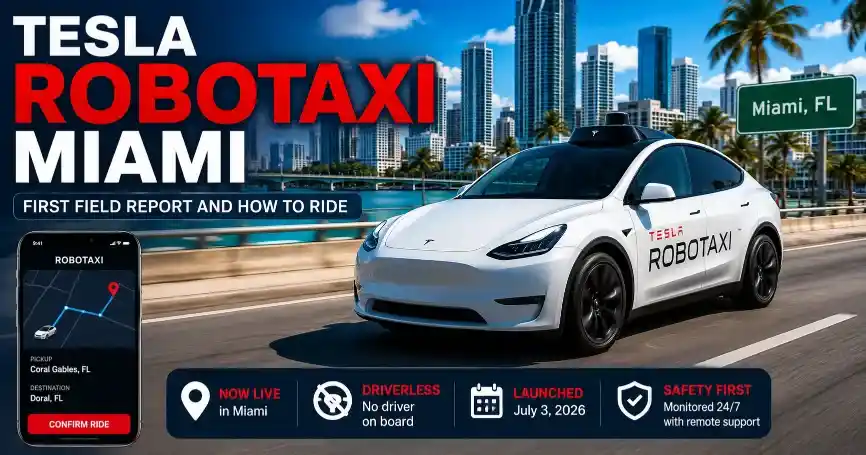
Tesla launched its unsupervised robotaxi service in Miami on July 3, 2026, timed just ahead of the holiday weekend. This made Florida the third state, after Texas and California, to host Tesla’s driverless network. Miami became the first city outside Texas and California to get fully unsupervised rides from day one, meaning no safety driver has ever been required in the car since launch.
That detail matters more than it might seem. Most robotaxi operators, including Tesla itself in earlier markets, tend to ease into a new city with a supervised phase before removing the human backup entirely. Miami skipped that step altogether, a sign of how much confidence Tesla has built in its self-driving software after more than a year of real-world data from Austin, Dallas, and Houston.
For anyone who read our Tesla Robotaxi Explained breakdown of the full national rollout, Miami slots in as one of the seven cities Tesla announced for expansion during the first half of 2026.
Tesla Robotaxi Miami Coverage Area
The launch zone covers roughly 10 to 14 square miles in western Miami-Dade County, stretching from Coral Gables to Doral. It’s bounded to the north by SR-826, the Palmetto Expressway. Several major connector roads fall inside the zone too, including US 41, the Tamiami Trail, along with SR 968, 953, 959, and 972.
For anyone unfamiliar with the area, this places the initial coverage squarely in Miami’s western suburbs rather than the tourist-heavy waterfront neighborhoods most visitors associate with the city. That’s a deliberate choice, letting Tesla gather driving data in a mix of residential streets and busy connector roads before tackling the denser, more chaotic traffic patterns closer to the coast.
Local residents in Coral Gables, Doral, and the surrounding neighborhoods are effectively the first Miamians with real access to the service, while anyone living or working near the coast will need to wait for a future expansion phase. Given how Tesla handled Austin’s rollout, where the zone eventually grew from a small pilot area to the full metro region, a similar widening in Miami over the coming months seems like the likely next step, even though no official timeline has been announced.
What the zone doesn’t cover matters just as much. Downtown Miami, Brickell, Wynwood, the Design District, and Miami Beach all fall outside the current service area. Miami International Airport does sit within the boundary, though Tesla vehicles aren’t yet authorized to handle terminal pickups or drop-offs directly, an important detail for anyone hoping to grab a Robotaxi straight off a flight.
How to Book a Tesla Robotaxi in Miami
Booking works the same way it does in every other Tesla robotaxi market. Download the dedicated Robotaxi app, available on both iOS and Android. Sign in using your existing Tesla account credentials. Enter a destination within the service area, review the fare estimate, and confirm the ride.
Expect a waitlist. Tesla has followed this same access pattern in Austin, Dallas, and Houston, gradually widening availability rather than opening the app to everyone at once. Early riders in Austin reported wait times as long as 15 minutes or more during the first weeks of access. Miami riders should expect something similar while the fleet is still small.
Once a ride is confirmed, the process mirrors Uber or Lyft closely enough that most riders won’t need any real learning curve. The app shows the car’s live location as it approaches. A notification arrives once it’s pulled up to the pickup spot.
What Early Riders Have Experienced
Field reports from the first two weeks paint a fairly detailed picture of how the car handles Miami’s specific conditions. One review documented the vehicle pulling smoothly to the right lane and coming to a complete stop when an ambulance approached from behind with its sirens on, a scenario that tests real-world judgment rather than simple lane-following.
Florida’s weather posed its own test. The same field report described the car driving through two deeply flooded stretches of road at a steady eight miles per hour without hesitation and without any remote intervention needed. That’s a meaningful data point, since Tesla’s approach relies entirely on eight cameras rather than the combination of cameras, lidar, and radar that most other robotaxi operators use, making heavy rain a tougher technical challenge for a camera-only system.
Not everything has gone smoothly. Riders reported the app displaying an “unable to start your ride” error in a large majority of trip attempts during the early rollout, requiring a call to remote support to get the trip moving. This kind of software hiccup, rather than a driving mistake, has become a familiar pattern across nearly every new Tesla Robotaxi city during its first few weeks, suggesting it’s more of a backend scaling issue than anything related to the self-driving system itself.
Ride quality itself, once underway, was described as the smoothest across the three markets tested so far, Austin, Houston and Miami, with fewer small corrections and hesitations than reviewers noticed in Houston specifically. One field report even noted the vehicle handling a small piece of tree bark that fell onto the road ahead of it, pausing for nearly five minutes before deciding it was safe to proceed over the debris without any remote intervention needed.
The Bigger Strategy Behind a Small Launch Fleet
Only two or three vehicles were actively running on Miami’s opening day, a number that might look underwhelming given the attention the launch received. A visit to a staging lot near Miami International Airport just two days later told a different story, with roughly two dozen Cybercabs and about a dozen Model Y robotaxis parked and waiting.
That staging location isn’t a coincidence. It sits close to Miami International Airport and only a few miles from a Waymo depot still under construction nearby, suggesting Tesla is deliberately positioning itself near a major transit hub before its most direct driverless competitor gets fully established in the same market.
The visible fleet on launch day and the actual fleet waiting in reserve rarely match in any Tesla Robotaxi city so far, based on the pattern seen in Austin and Houston as well. Tesla appears to prefer a slow, visible ramp-up on the app-facing side, even when the hardware to expand quickly is already sitting nearby, likely to keep early ride quality high while the software continues adapting to each new city’s specific road quirks.
Tesla Robotaxi Miami vs Other Cities
Compared to Austin, Houston, and Dallas, Miami’s launch zone is noticeably smaller and more tightly geofenced, reflecting Tesla’s typical caution when entering a market with unfamiliar road conditions, denser tourist traffic, and heavier seasonal rain. Ride quality reports have actually favored Miami over Houston so far, though it’s worth remembering the Miami fleet is still tiny compared to the more established Austin market, where the service area has since grown to cover the entire metro region.
Weather is the biggest technical variable separating Miami from Tesla’s Texas markets. Houston and Dallas both deal with heavy rain occasionally. Miami’s summer storm patterns bring a more consistent, near-daily test of the car’s camera-only system, since Tesla relies entirely on visual input rather than the lidar and radar combination used by competitors like Waymo. Early results suggest the system is handling that specific challenge better than skeptics expected, though a handful of storm-heavy weeks is still a small sample size to draw firm conclusions from.
What Comes Next for Miami’s Coverage Area
Every other Tesla Robotaxi city has followed the same trajectory: launch small, then widen the geofence once enough driving data builds confidence in a broader area. Austin is the clearest example, growing from a single small zone into coverage across the entire metro area within roughly a year of its initial pilot.
If Miami follows that same pattern, the neighborhoods currently left out—Downtown, Brickell, Wynwood, the Design District, and Miami Beach—are reasonable candidates for the next expansion phase rather than a sign they’ve been permanently excluded. Denser urban cores and heavier pedestrian traffic typically come later in Tesla’s rollout sequence, once the software has proven itself in lower-density suburban conditions first. Given the staging fleet already positioned near the airport, an expansion announcement within the next few months wouldn’t be surprising, though Tesla hasn’t confirmed a specific timeline for widening Miami’s zone.
Frequently Asked Questions
Is the Tesla Robotaxi available in Miami right now?
Yes, since July 3, 2026, though only within a roughly 10- to 14-square-mile geofenced zone in western Miami-Dade County, covering areas like Coral Gables and Doral rather than the entire city.
Does the Tesla Robotaxi cover Miami Beach or downtown?
No. The current service area excludes downtown Miami, Brickell, Wynwood, the Design District, and Miami Beach entirely. Coverage is limited to western Miami-Dade for now.
Can I get a Tesla robotaxi from Miami International Airport?
The airport falls within the service boundary. Tesla vehicles aren’t yet authorized for direct terminal pickups or drop-offs, so airport access remains limited compared to the rest of the zone.
How does the Tesla Robotaxi handle Miami’s rain?
Early field reports describe the vehicle navigating flooded streets at low speed without hesitation or remote intervention, though Tesla’s camera-only approach faces a tougher technical test in heavy rain than systems that also use lidar and radar.
Is there a waitlist for the Tesla Robotaxi in Miami?
Likely yes, following the same rollout pattern Tesla used in Austin, Dallas, and Houston, where access expanded gradually rather than opening to every rider immediately.
Is the Tesla Robotaxi better in Miami than in other cities?
Early ride quality reports have favored Miami slightly over Houston, though the fleet size remains much smaller than in Austin, so it’s too early to call it a clear leader among Tesla’s active markets.
Final Thoughts
The Tesla Robotaxi in Miami is real. It’s still a small, carefully geofenced operation rather than a citywide service. The early rides have shown the car handling genuinely tricky situations, like flooded streets and emergency vehicles, competently, while a small staging fleet near the airport hints at faster growth ahead.
Anyone hoping to ride today should temper expectations around coverage, not capability. The technology has already handled real edge cases well in its first two weeks. It’s the map, not the software, that currently limits how many Miami residents can actually try it. For the full national picture, including pricing, safety data, and how Miami fits into Tesla’s broader rollout, the Tesla Robotaxi Explained guide covers the rest.
Written by the MagazineMedia Tech Desk, covering the technology and companies shaping how we live and work.